Blog
How to Cook With a Titanium Cup Without Burning Your Food
I was on day two of a four-day solo trip in Moab, Arches and Canyonlands back to back, and I made a decision that felt brilliant at the time: I'm going to make oatmeal in my titanium cup instead of just pouring hot water into a packet.
Five minutes later the bottom of my cup was coated in a black, carbonized layer of burnt oats. My campsite smelled like a bakery fire. I ate it anyway because I was starving, and I can confirm that burnt oatmeal tastes like an ashtray mixed with regret.
I made two mistakes. First, I used too little water. Second, I cranked the stove to max because I was hungry and impatient.
Titanium is an unforgiving cooking surface — it conducts heat fast, has almost zero thermal mass, and creates hotspots the size of a quarter on the bottom of the cup. Once you understand why, you can stop fighting it and start actually cooking in it.
🔥 Why Cooking in Titanium Is Harder Than It Looks
Titanium's thermal conductivity sits around 17 W/m·K — faster than stainless steel but not as wild as aluminum. The real problem isn't the metal. It's the wall thickness.
A standard single-wall titanium cup has walls 0.3 to 0.5 millimeters thick. A home saucepan runs 1.5 to 3 millimeters. When your stove flame is concentrated on a coin-sized spot on the bottom, a 0.3-millimeter titanium wall doesn't have the thermal mass to spread that heat sideways. What you get is a blistering-hot center with lukewarm edges — which is why your food scorches dead center while the edges are barely warm.
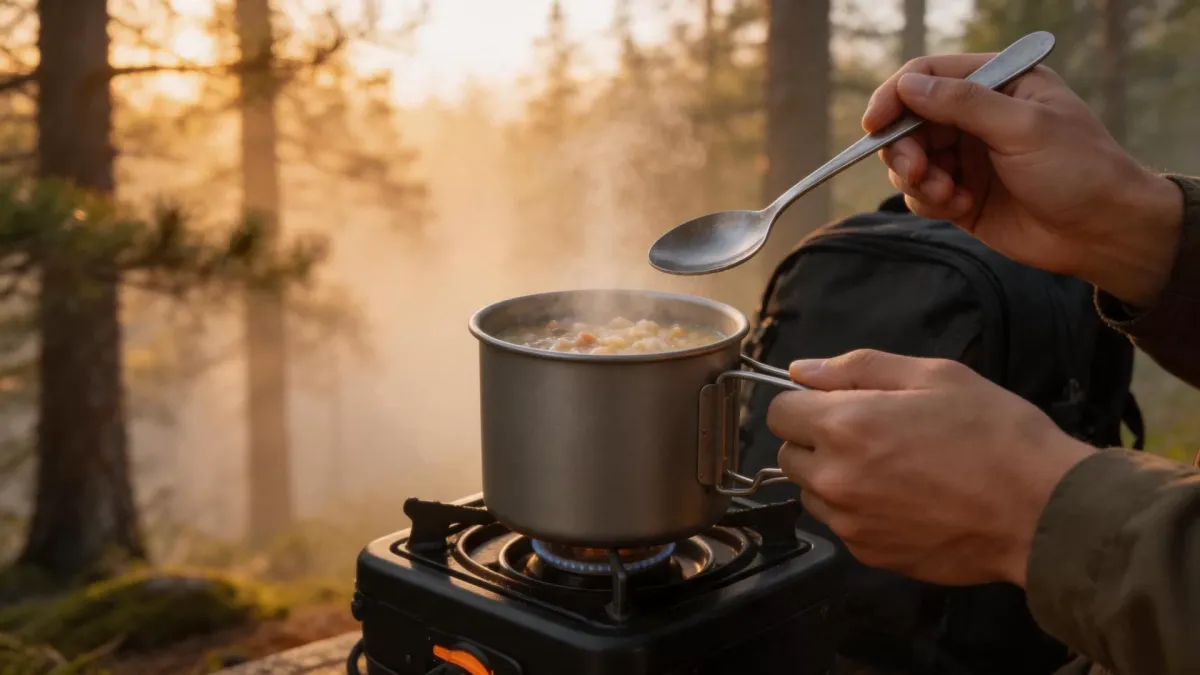
Dave — the North Cascades guide with 15 years on the trail who's shown up in every gear conversation I've had — watched me burning oatmeal one morning at Many Glacier. He didn't lecture. He just said, "Treat it like a saucepan half its size." Then he turned my stove flame down so low I thought it wouldn't boil water. Three minutes later, the oats were creamy, not carbonized, and I felt like an idiot for every meal I'd ruined before that.
That one sentence rewired how I cook in titanium. Everything below flows from it.
I tested this deliberately on the next three trips after that Glacier morning. Same cup, same stove, same altitude, but with Dave's "half-size saucepan" rule in my head. Not a single burned meal across fourteen days of cooking — including a box of Annie's mac and cheese I'd previously written off as something you can't make in a cup. The cup didn't change. My understanding of it did.
📐 The Three Rules of Not Burning Your Food
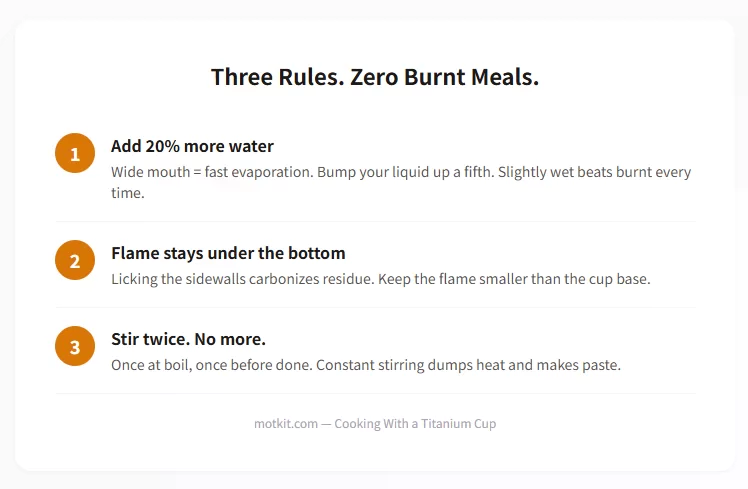
Rule 1: Add 20% more water than you think you need. A titanium cup has a wide mouth relative to its volume. Water vapor escapes faster than it would in a narrower pot with a lid. Whatever water ratio or liquid amount you'd use in a regular pot, bump it by a fifth. Slightly wet oatmeal can be rescued by letting it sit for another minute. Burned oatmeal goes in the fire pit.
Rule 2: The flame stays under the bottom. Never climbs the sides. This is the rule that changed everything. If your flame wraps around the edge of the cup and licks the sidewall — and there's no liquid behind that part of the wall because you're cooking a small portion — whatever residue is on that wall (sauce, starch, oatmeal bits, cheese powder) will carbonize instantly. Keep the flame diameter smaller than the cup base. The liquid inside absorbs the bottom heat. The dry wall has nothing to absorb it.
Rule 3: Stirring has a schedule. Two times only. Once when the liquid hits a boil — to lift any starch or oats that have settled on the bottom. Once again a minute or two before you're done. In between, leave it alone. Stirring constantly dumps heat out of the cup and turns your oatmeal into wallpaper paste. You're cooking breakfast, not churning butter.
Already own a cup? I broke down which three decisions actually matter when you're buying one in How to Pick a Titanium Cup. The handles and wall thickness you choose affect cooking more than you think.
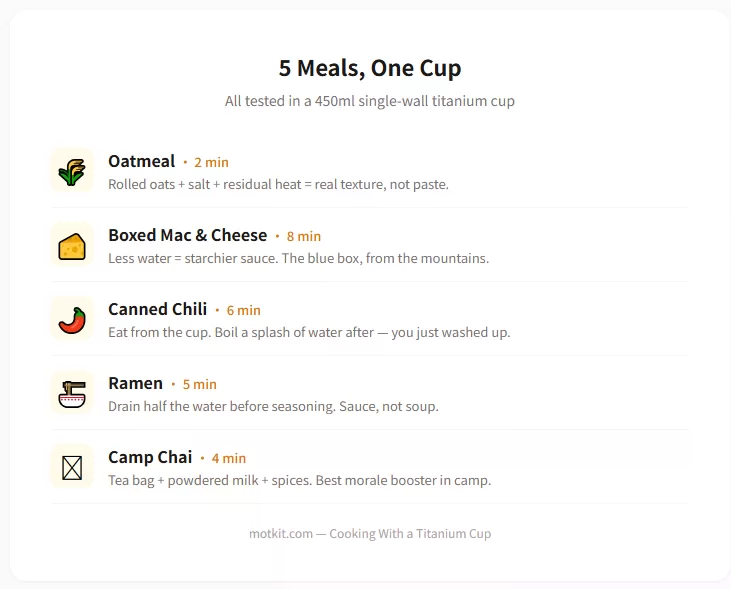
🍳 Five Actual Meals You Can Make in 450ml
These are all things I've actually made. Not Pinterest fantasy camping meals. Real stuff, cooked when I was hungry and cold and had one cup and one stove.
1. Oatmeal. Two minutes. Water, rolled oats, a pinch of salt. Flame on until it bubbles, stir once, cut the heat. Let it sit for thirty seconds — the titanium holds enough residual heat to finish the cook even off the flame. Sprinkle crushed almonds and a drizzle of honey on top. This tastes three times better than the "just add boiling water" instant packet because the oats actually cook instead of soaking in cooling water. You get texture, not paste.
2. Boxed mac and cheese. The blue box. Annie's if you're feeling fancy. Boil the pasta in just enough water to cover it — less water means the starch concentrates and makes the sauce creamier. When the pasta's done, drain most of the water, drop in the cheese packet and a pad of butter, stir on residual heat. This is the meal that convinced me a titanium cup was a real cook pot, not a novelty. You're eating mac and cheese out of a cup at 9,000 feet. Life is good.
3. Canned chili. Hormel, Wolf Brand, whatever's in the camp box. Dump it in, medium-low flame, stir when the edges start bubbling. The key: let it sit untouched on low heat for a full minute after it's hot — the flavors actually meld instead of tasting like microwaved canned food. Eat straight from the cup. When you're done, boil a splash of water in the same cup and drink the vaguely chili-flavored water — you just cleaned and hydrated yourself in one move.
4. Instant ramen with dehydrated vegetables. Any Asian grocery store ramen works. Boil water, drop the noodle brick in, toss the veggie packet in with it. Key technique: drain half the water before adding the seasoning, not after. Concentrated broth, better flavor. You're not making soup — you're making noodles with a sauce.
5. Camp chai. Boil water, drop in a black tea bag, stir in powdered milk, add cinnamon and ginger powder (pre-mix these at home in a tiny ziplock). Simmer one minute, cut the heat, let it sit for two more. A hot mug of chai on a freezing morning at Many Glacier Campground did more for my morale than any piece of gear I own.
🧽 How to Clean a Burned Cup
Don't use steel wool. Titanium is soft enough to scratch, and while scratches don't hurt the cup, they look like you fought a raccoon with it and lost.
The fix: put a spoonful of baking soda in the cup, add half a cup of water, put it back on the stove, boil for five minutes. Dump the water, rub the burned spot with your finger or a soft cloth. Stubborn burns get a second round. No bleach, no heavy-duty degreasers — you're going to eat and drink out of this thing. Soap and warm water for everyday cleaning is all you need.
One more trick that's saved me more than once when baking soda was out: toothpaste. The same paste that handles coffee stains on a ceramic mug works on titanium — rub it on the burned spot with your finger or a soft cloth, let it sit a minute, rinse. The mild abrasive lifts the scorch marks without scratching the metal the way steel wool would. It's the one cleaning hack you can find in any camp kitchen or hotel bathroom. I've used it on mug rings, burnt chili residue, and the gray film that builds up after a week of flame use.
Titanium doesn't hold onto smells, doesn't harbor bacteria, and doesn't rust. It's the lowest-maintenance piece of cookware you'll ever own. You just need to not set breakfast on fire in it first.
What's the weirdest thing you've ever cooked in a titanium cup — the meal that shouldn't have worked but somehow did? Drop it in the comments. I'm genuinely curious, and I read every one.
Disclaimer: I work with MotKit, but I only recommend gear I've personally used or would trust with my own weekend trips. This article contains no paid plugs — just honest opinions from a guy who spends too many nights in the woods. Product weights and prices are based on publicly listed specs as of July 2026.